Pottery Barn rugs to run from…
I like Pottery Barn. They have some cool household items and furnishings, some of which are good quality at a good price.
Their rug department however, is a different story… and in the rug cleaning world the term “POTTERY BARN RUG” is becoming synonymous with “PROBLEM RUGS.”
First of all, Pottery Barn does carry some VERY nice woven rugs coming from Afghanistan in particular. They have some very decorative wool hand woven rugs in their Arzu line. I like that they are funding a craft that is allowing women in Afghanistan to make a living for themselves and helps support education in the region. The ARZU project is a production line to absolutely support.
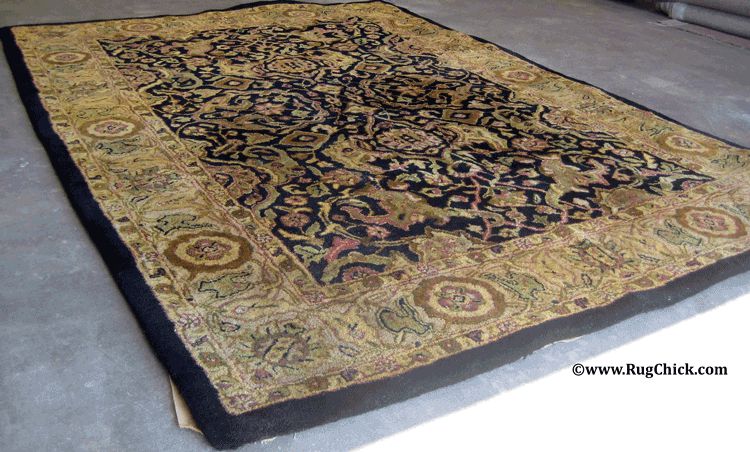
As you recall, you determine if a rug is “woven” by whether you can see the design on the back of the rug exactly as you see it on the front, like this:
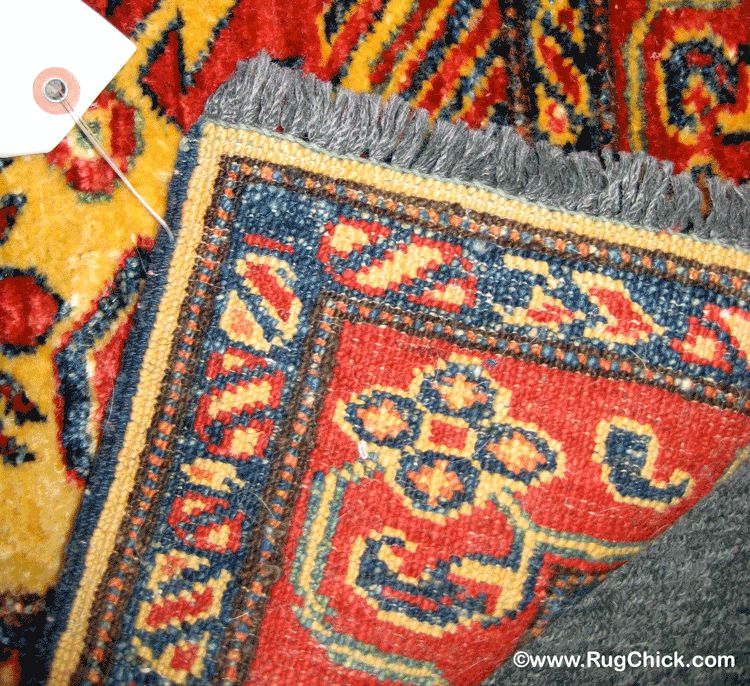
Woven wool rug.
So the WOVEN rugs that Pottery Barn is selling are very good rugs. But that is just a fraction of what they sell today.
The problems are coming from their “other” rugs, in particular their TUFTED rugs and other specialty pieces using “natural” fibers.
Tufted rugs have a material on the back, like this:
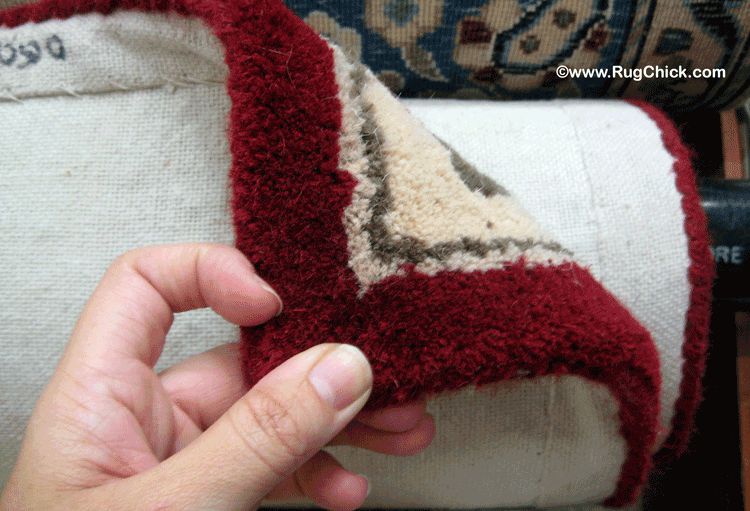
Tufted rugs have canvas material on the back.
Whoever is running their TUFTED rug department (including their Pottery Barn Kids rugs), and their “earth friendly” rug department are choosing some of the most difficult, if not impossible, rugs to live with and maintain.
As a professional cleaner (or a consumer shopping for rugs), these are the ones to keep an eye out for to avoid… or be very careful with:
RUG TO RUN FROM: TUFTED RUGS FROM INDIA
We wash hundreds of rugs a week, so we see “flawed” product relatively quickly because we wash a whole host of natural and synthetic woven and tufted rugs.
Without a doubt, there is something seriously wrong with the tufted rugs coming out of India today, and in particular the lines being sold at Pottery Barn. These are the problems we are seeing on a consistent basis from TUFTED rugs from India:
1. “Burnt Rubber” Odor from the Latex
I’ve discussed this problem on this blog before, the strong pungent odor that comes from these India tufted rugs. The latex is either mixed with filler that has contaminants that off-gas over time, or the latex itself has soured before application. Both lead to a smell that is similar to a mix between burnt rubber or asphalt and stinky dirty socks.
It is AWFUL. And it is NOT correctible to my knowledge.
And if you don’t want to just take my word for it, here is just one post where SCORES of people post their smelly horror stories with these problem India tufted rugs from Pottery Barn.
To Pottery Barn’s credit, as you can see in the thread over several years of posts, you see that there is an “easy” exchange process for those who want to replace their rugs for ones that do not smell (i.e. the rugs WITHOUT latex used in the construction).
What I do not understand is why with such a high volume of documented complaints on-line, why they would insist on carrying so many TUFTED rugs in their Kids selections. When you have kids crawling and playing on rugs, why would you let them breathe in those *bad* odors?
I keep seeing statements that the odors are not “harmful” – but isn’t the fact that something smells bad enough to get away from it mean your body’s warning system is telling you it’s *bad*?
The problem seems to get worse over time, and becomes more noticeable when rolled up for a time, or closed up in a room with no air circulation. It also becomes more apparent when it gets wet – which means if you ever spill on it, or need to have it cleaned, there will be an issue.
So, in the worst case situations, these rugs are not cleanable. (Why would you own a rug you cannot clean?)
Here’s an example of a backing of one of these types of problem tufted rugs:
Tufted rug. The material is covering up latex, and it smells.
Here’s the labels on the back:
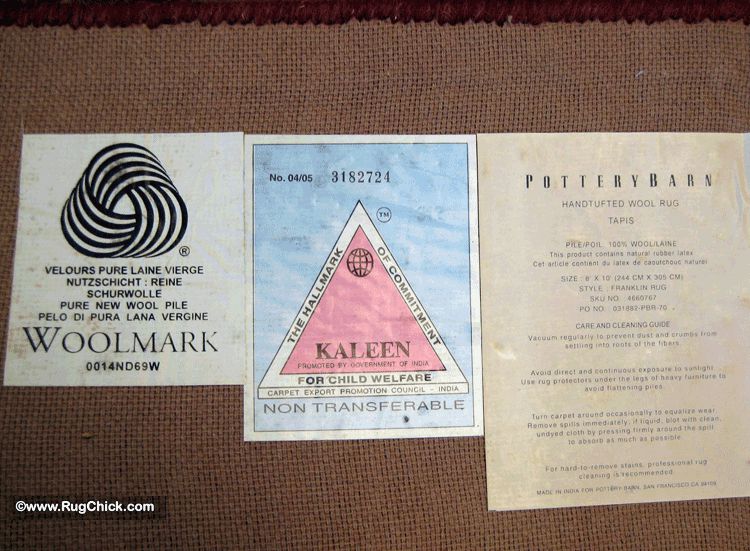
Labels. “Natural rubber latex” tends to be the smelly culprit.
2. Delamination of the Latex
In the India Tufted rugs, we are also seeing today a lot of “filler” being used with the latex mixture that simply cannot hold up to age, being walked on, or moisture. The latex delaminates and crumbles and cracks. One of the reasons they cover it up with that material is because without it you would have a HORRIBLE mess on your floor.
Here’s an India Tufted rug that is delaminating:
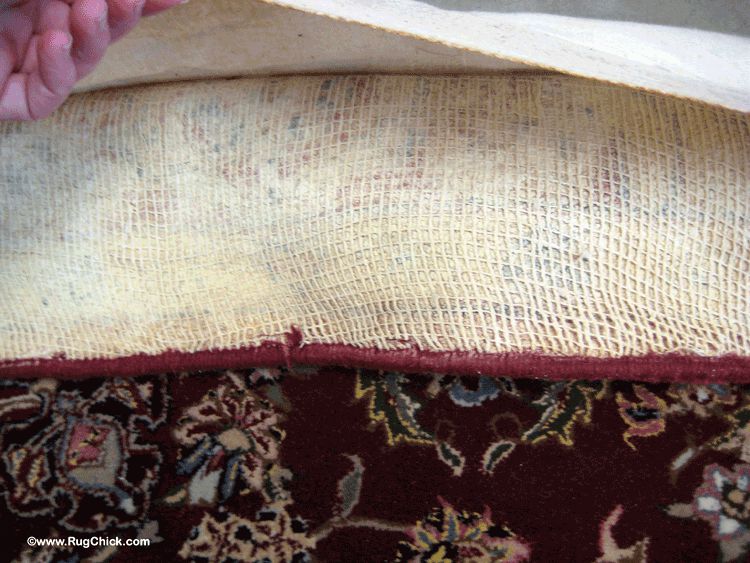
Latex is crumbling.
Here’s another one:
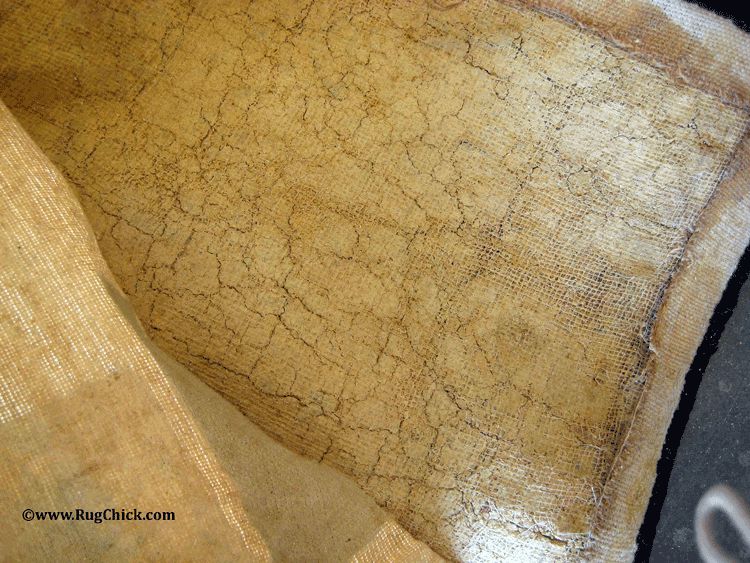
Backing has fallen off and latex is crumbling away.
The problem with these inferior grade India Tufted rugs, besides the mess, is that when this latex crumbles away the rug loses both its shape and the fibers themselves. This means that if the owner wants to continue using this rug, the professional rug cleaners needs to wash the piece very carefully, remove as much *bad* latex and filler as possible from the back side, and then apply a new latex coating (without the filler powder) and a new material backing.
This type of repair is NOT inexpensive. So people who choose to buy a TUFTED rug because it’s a bit cheap than a WOVEN rug, will end up having to pay for a wash and a repair – so it ends up costing them more to care for that rug.
Tufted rugs also only last years, whereas woven rugs last for decades, if not a century or more (if woven well and properly cared for). So as with all things, if you pay a cheaper price for it… there is probably a reason why…
…and you will find out soon enough.
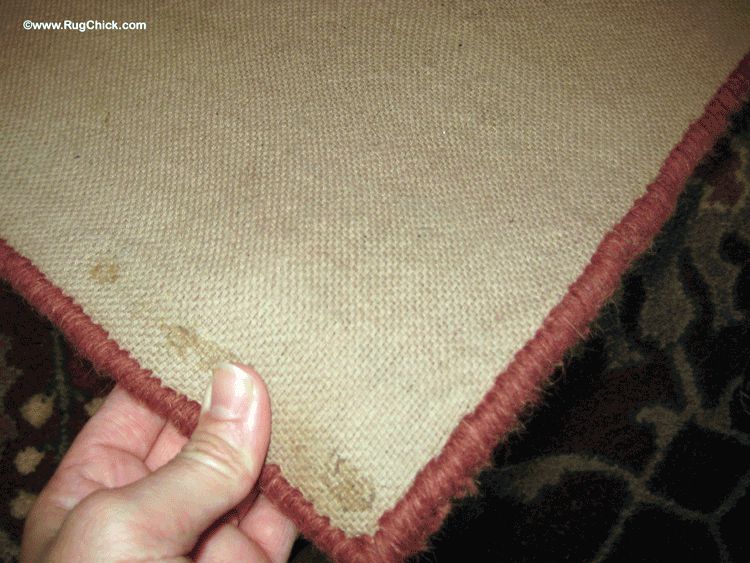
3. Discoloration and “Uglying” of the Backing Material
The canvas or linen or jute backing material is covering up ugly latex. When the rugs are spilled on, or when they are washed, this backing gets water marks, latex discoloration, and browning as a result. This is a common sight on the back of TUFTED rugs:
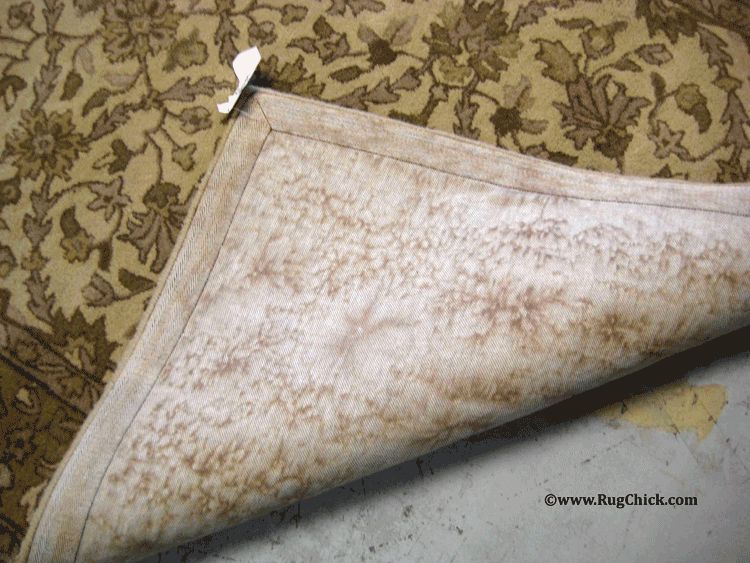
India Tufted rug. Backing gets discolored.
Sometimes the discolorations are some “yellowing” from the cotton/linen/jute used, and can be improved with some additional cleaning of the back:
But on the whole, if you own a TUFTED rug, and particularly the ones from India with the added filler in it, you will be getting a rug with a blotchy and marked backing after it is cleaned. The material can be replaced, but I find that most people when given a substantial repair estimate do not really care what the back of the rug looks like as long as it is clean and the front looks good. They understand that washing a rug like this, that cotton backing acts as a “filter” as latex, filler, soil, and water all flows through it.
4. Buckling of the Top Side and Shedding of Fibers
With TUFTED rugs, how “square” it is or isn’t is based on that latex and the material backing. So when it begins to delaminate, the shape of the rug gets lost. The top side get waves in it, Sometimes a few:
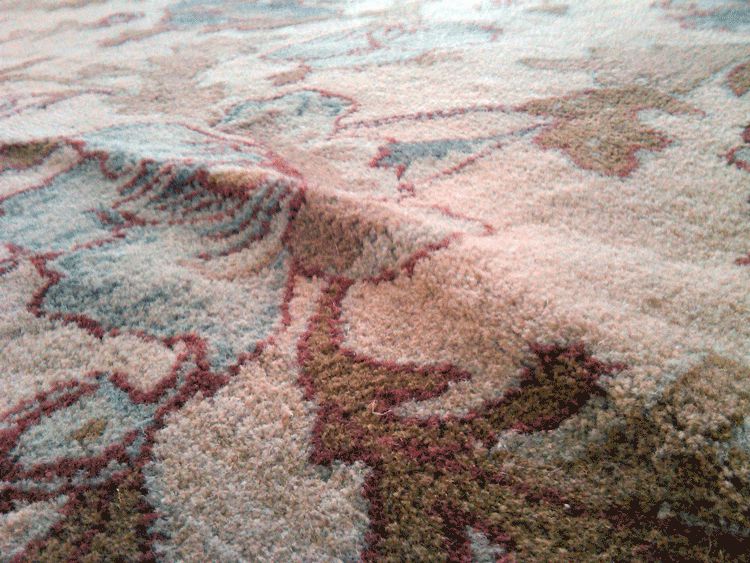
Waves on top side.
Sometimes A LOT:
Bad latex leads to lots of buckling in the rug.
Coinciding with the deterioration of the latex, as mentioned before, the tufts of wool can pull loose when there is no strong latex holding it in place. You might find full strands pulling away from the rug, or if the rug is made of inferior grade wool (sometimes in India this can come from being sheared from dead sheep), then it will break off and shed.
You will notice when you are on the Pottery Barn website they mention that “some” shedding is expected from wool rugs. This is true. Wool is spun with many short strands together, and then the rug is shaved after being crafted to have an even pile on the front, so yes, there will be some shedding.
However, better quality production will WASH a rug after it is woven to remove many of these loose short clippings. So “some” shedding should be very little. If you have a rug that is consistently shedding, and when you run your fingers across the face it breaks away with pressure or light pulling, then that is a PROBLEM rug. That is a sign of bad wool. which you often will find in TUFTED rugs that are at cheaper prices.
Wool is strong. It is literally the best fiber for use in rugs.
If you ever have a wool rug that feels brittle, or breaks easily, that is a bad sign. Either it was bad quality wool to begin with, or it has been so heavily chemically processed, that it has become weak. You want to run from rugs like these.
RUG TO RUN FROM: CHUNKY WOOL SHAG RUGS
I’m not sure why these rugs were created. Our nickname for these rugs are noodle rugs, because they look like big noodles:
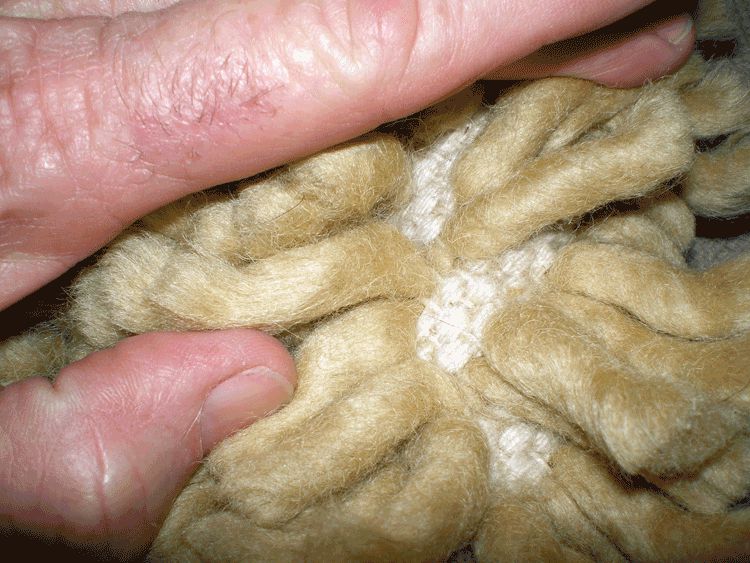
Noodle shag rug.
They are big chunks of wool strung into a material backing. Sometimes they have latex on the backing, and sometimes they are just loosely strung in, which makes them state that the rug is “woven” when I would not of course ever call these “hand woven” or “hand knotted” rugs.
Here’s the label:
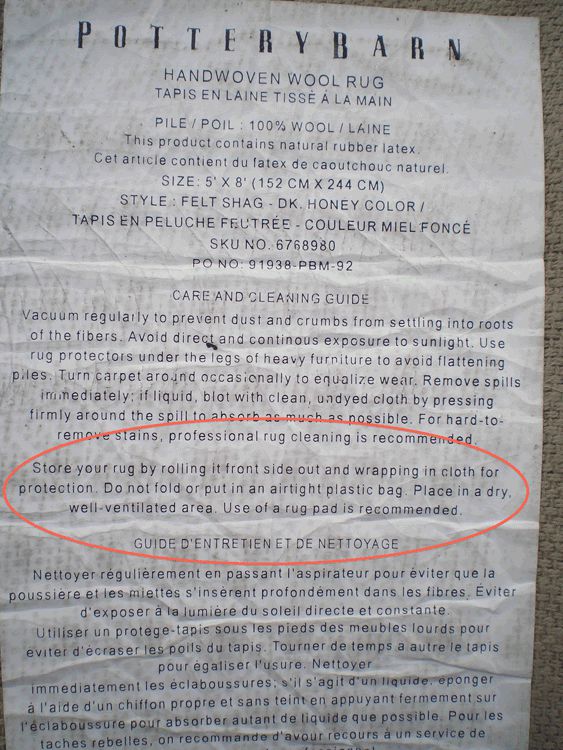
Label says keep in a “well-ventilated area” … which means it STINKS too
If you see these rugs at first you might look kind of cool, especially in their variety of colors… …but if you have ever owned a shaggy dog, then you will understand why these rugs are super tough to maintain and care for. The problem is, getting soil, lint, and general “fuzziness” out of these fibers is as tough to do as combing out those spurs and knots are from your shaggy dog’s fur.
These rugs often require a great deal of extra hand work after cleaning to literally comb through row by row to try to “pull up” anything that was tangled up too much in that felted type of wool to wash away.
This means cleaning these rugs, even though they are not super expensive to buy, will often cost you more to do than if you had gotten that higher price woven rug.
This is one of those rugs that when you first see them, you think they are cool, and then you realize that it was a completely impractical choice for a floor covering and that you should have run from it.
RUG TO RUN FROM: “EARTH-FRIENDLY” PLANT FIBER RUGS
First of all, the MOST earth friendly rug you can own is a woven wool rug. Wool is a completely sustainable and renewable resource that grows back year after year.
But several stores are crafting rugs they deem as “earth friendly” from plant fibers and attempting to imply that these are also good rug choices. These rugs are made from SISAL, JUTE, and RAYON.
The problem with sisal and jute, besides the fact that they feel like wicker furniture instead of a soft rug fiber like wool, is that they both release oil when wet, yellow, and get brittle with age.
What is interesting is that on their website they state that sisal is “stain-resistant” when actually stains are quite difficult to remove from sisal. When a spill gets on it, and oils from the plant fibers release, it makes darker areas that can be tough to even out. And if the owner of the sisal rug has pets, and the spill is pet urine, the rug cannot be soaked to remove the contaminants because the cloth border binding may shrink, or the rubber/latex backing may have structural problems.
To be safe with sisal, you need to use it in areas where you don’t feel there will ever be any spills, and no pets. And you just need to know that if you have a spill disaster on the rug, that you may have to replace the rug.
With jute, when it gets wet it likes to yellow and brown badly. For some strange reason, jute is being used as a foundation fiber on many of today’s lesser quality rugs. (I guess I answered the “strange reason” – it’s used because it’s cheap! LOL.)
Here’s a cotton rug with jute foundation warps that are creating yellowing in this rug:
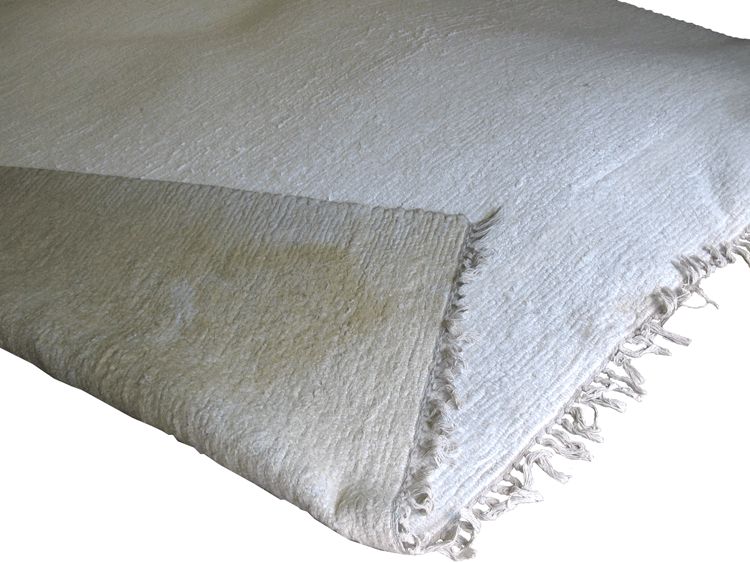
Jute on the inside of this rug is creating yellowing in the cotton rug.
When you wash these rugs, a cotton shampoo with an acid rinse can help lessen the browning of both the jute and the cotton, but over time this will become a more noticeable problem (especially if spills occur on the rug).
The problems with rayon/viscose rugs, which is used as artificial silk, are many that I’ve covered in depth on this blog. It bleeds and fades, it breaks, and it yellows.
These rugs all look great when they are brand new, and then they proceed on getting “less pretty” with time. I know I keep hammering how woven rugs are the better choice, but that’s because after DECADES a good quality woven rug will still look like it did when new…
… but these plant fiber rugs begin to look worse in just a year. And if you spill on them, they look worse even faster.
Here is a Pottery Barn rug that has the TRIFECTA of tricky components: RAYON face fibers, JUTE foundation, and LATEX backing:
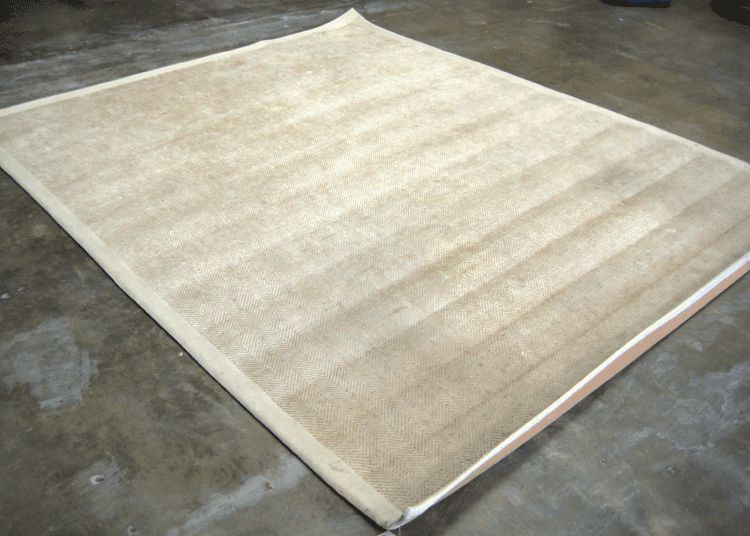
When this rug was new, it looked more like “silk” and was whiter. The fibers of rayon and jute, both of which yellow with moisture and age, are giving this rug a yellower look over time.
The label indicated the “fragile” strength of this rug in that it warns against many things: spills, sunlight, heavy furniture, and spot removers:
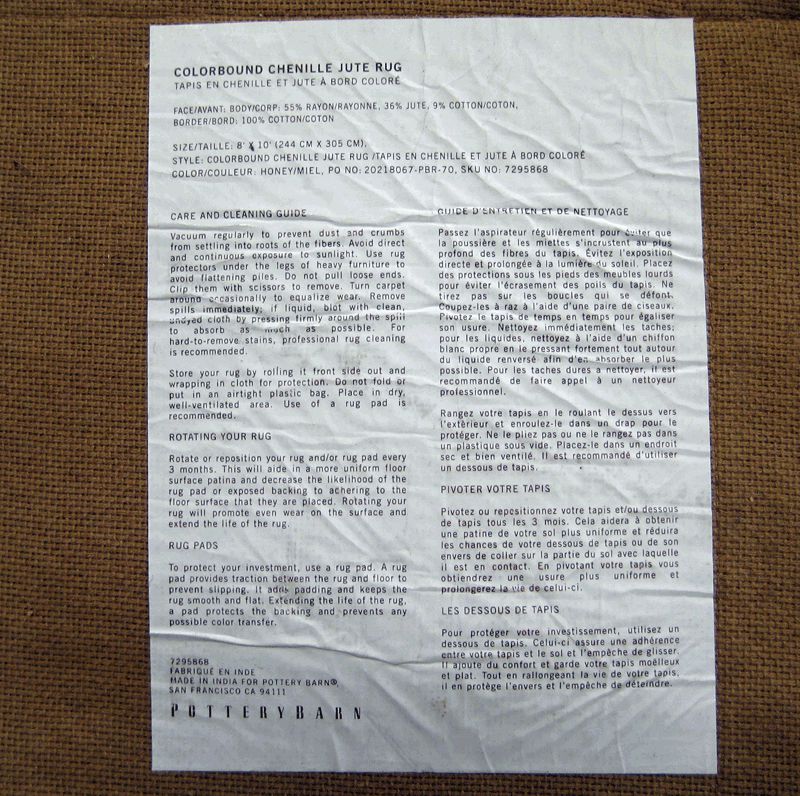
Warnings, warnings, warnings…
The owner did use some household spot removers on this rug, which due to the rayon did in fact make it lose what color it had in the fibers to begin with:
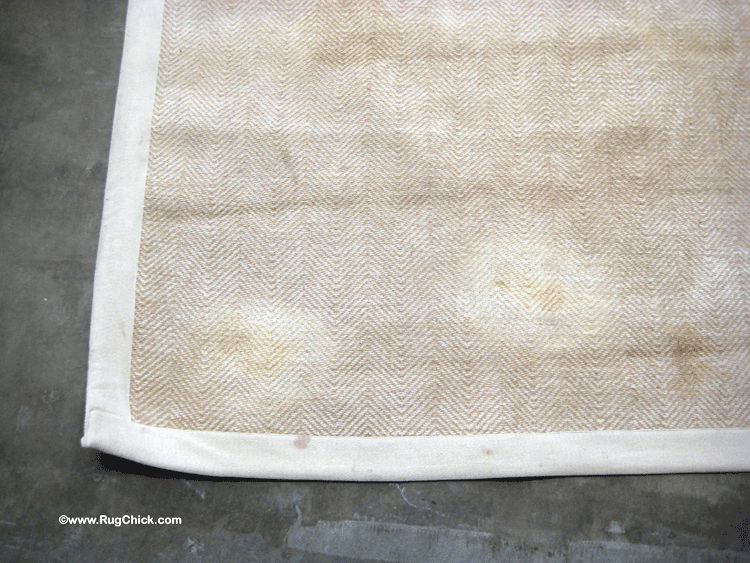
Sensible spotting led to bad results.
The fact is, if this rug had been wool this result would not have happened. It’s because the fibers are weak and sensitive that there was a problem.
(By the way – for safe spotting tips for spills on wool rugs, here are some safe rug care tips.)
You can see with this rug also, we have the LATEX factor, where a rug with any type of furniture on it is creating creasing problems in the backing construction itself.
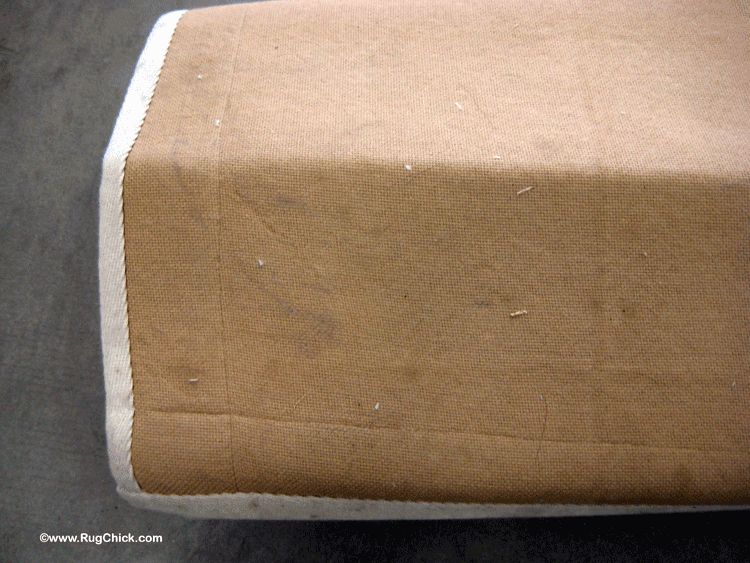
Backing is not strong on plant fiber rugs.
Now, the person who bought this rug did so because she liked the look of it, and she believed that it was a quality piece because of the price she paid. She was not aware that the cloth binding material used would begin to buckle, that the backing latex would lose its flat shape, that the jute and rayon would begin to yellow, and that she would never be able to spill anything on the rug without it being a disaster to the way the rug looked.
With plant fibers it is sometimes possible to bleach out some problems, but this is extra work above and beyond regular cleaning, so it makes it more money to maintain this type of rug.
And that is what this all comes down to…
…EDUCATION.
The fact is, when consumers realize the differences between woven rugs and tufted rugs, or wool rugs and plant fiber rugs, and they are given the pros and cons of each, then they feel they can make educated buying decisions. It’s when they buy a rug they like, and discover problems they were unaware of – strong odor, weak fibers, bad latex – that is when they feel they were sold bad goods. That’s when consumer feel ripped off…
…even if it was not a very expensive rug to begin with.
So now you know some of the common problem rugs being sold at Pottery Barn, and can choose whether to buy them or not – and if you are a cleaner, whether you want to clean them (or CAN clean them…) or not.
My hope is that there are enough complaints coming in about these specific rugs, that they are changing the rugs they carry. I don’t think any company likes to be knows for selling “rugs to run from.” And I know us rug cleaners don’t enjoy cleaning them. =)
Happy Rug Cleaning!
– Lisa
P.S. Just a heads-up that we are currently accepting applications for next year’s Textile Pro Program, which is an advanced rug and fine fabric care training program by Jim Pemberton and myself. If you think you might have what it takes to be a Textile Pro, then send an email with the subject RUG TRAINING to textilepros@gmail.com. Merry Christmas & Happy New Year!